Over the past 5 years, I have transformed my health and lifestyle to a degree I did not expect. I feel good, rarely get sick, and perform in endurance events near an elite level. However, it's not enough. Through reading books and talking with individuals who do this for a living (Twitter at it's all time best), I have been able to find more ways to get to the next level. This one of those steps.
My sister and mother read "Clean" by Alejandro Hunger and executed his 21-day cleanse diet. After completion, both received great results: weight loss, improved skin complexion, and superb immune revitalization.
The ability to battle disease and sickness without the use of medicine or professional aid.
Furthermore, I want to be healthy.
Now, most people believe health is defined by the absence of disease, but that is a common misconception and just plain wrong. Well, not wrong, just half right. Health is a superior state of being. A state where anyone can reach their true potential. I know this sounds to good to be true (and kind of cheesy) but it is. It's that simple. It just takes a lot discipline, hard work, and determination.
It is a very strict, yet realistic diet. Let me explain:
-Two Smoothies a day
-One "hard" meal a day
-No dairy
-No citrus
-No bananas, grapes, or strawberries
-At least 5 liters of water a day
-No rigorous exercise
-A plethora of varietal nuts
The last one is going to be the interesting one.
I am training for the Philadelphia Half Marathon and in the middle of my training plan. I can't just stop exercising and let this diet take precedence. This is why I want to document this. I can't intake the amount of calories or food items I need to to recover properly. I will burn more calories than I will intake, even without working out. Now. add running and occasionally biking, weight loss will increase, my body fat percentage will decrease, and recovery will be compromised. I am not sure if it will affect my running while I am out on the road but I want to document this and see how it affects my performance.
The "Clean" diet perfect starts today and will end on November 11. The race is on November 17. This will run my training right into my tapering period. This will also allow me to utilize my normal nutrition during a race (Amino Vital Endurance, Clif Shot Bloks, and whatever other goodies I can get my hands on.
So let's get this started
Starting Weight: 192.5
Body Fat %: 18
Day 1
During the day, didn't feel much difference than normal, which is to be expected. I have been informed you don't feel a difference until Day 3 (where you feel moody and lethargic... I am looking forward to Day 3).
In the morning, I had a spinach and mango smoothie (it's as disgusting as it sounds).
For lunch, I had a chicken salad with pumpkin seeds, dried cranberries, and onions. No dressing. The only dressing you can put on your salads is oil and vinegar. On the side, I had some raw trail mix containing cashews, walnuts, raisins, and almonds, two avocados, and a 6 oz pack of raspberries.
For dinner, I had a avocado, lime, and ginger smoothie with flax seed (better than it sounds)
Workout
I did a nice and flat 7 mile run. I felt good, not great, but good. Moved at a 7:45 minute per mile clip. However, by mile 5, I started to feel sore in my muscles. Now, I don't know if this was mental because for some reason, I was expecting radical changes to my body when I started this diet but I did feel sore, which is an uncommon thing. I am very interested to see how I feel tomorrow morning. I plan to do a track workout tomorrow (oh yes, my favorite).
We will see...stay tuned.
Monday, October 21, 2013

Tuesday, September 17, 2013
Race Report: Ironman 70.3 Timberman (New Hampshire)
Note: This post is way overdue. I was working too hard on the PED Issue columns Part 1 and Part 2 (please read if you haven't) However, without further ado:
Ironman 70.3 Timberman

Before getting to the breakdown of my performance, this must be stated. The Timberman is by far the best race I have been a part of. It revolves around the beautiful Lake Winnipesaukee and immerses athletes and spectators alike into a wonderful festival atmosphere. From the Race Check In at the stunning Gunstock Ski Resort to the Athletes Lounge at the end of the race, it is the most organized, well run event I have involved myself in. This is the first time I have endured zero stress in the mandatory pre-race activities. It was almost relaxing. I never slept so well before a race and I look forward to doing this next year.
Now onto the race.
Pre-Swim
Perfect weather conditions, cloudy, low 60s, very low humidity. I am getting excited with anticipation that this may be the race I qualify for the 2014 World Championship in Mont Tremblant, Quebec while breaking 5 hours.
I start to visualize my success, but more importantly, I start to believe it.
Let's get started
The Swim
Due to my age bracket, I again, start the second to last wave. 8:09 am exactly. This sucks but also has it's advantages (Not waiting for the Porter John is by far the number one advantage).
The gun goes off. I am able to get into a nice rhythm without much chaos from the start.
I feel really good.
But wait....
....wait for the turmoil
....
It's coming
For the sake of Murphy's Law, water continually gets into my goggles. I stop at least 7 times to fix this during the swim, breaking my rhythm every effin time. I attempt to calm my nerves to the best of my ability but fail on multiple occasions during the course of the 1.2 mile swim.
I finally finish the swim and felt like I did it in about 38 minutes.
Lindsay clocks me in at 34 minutes flat... a personal best...but I don't realize this at the time.
Transition 1
I get out of the water and attempt to get my swim suit zipped down so the volunteer "strippers" (they have to fine a better name than this) can take it off rapidly. I try several times to get it off. I pass my mother and Lindsay as they are cheering me on. The pictures speak for it self


As you can see, I am struggling to zip down my wetsuit so I can take half of it off (look at the left picture, notice the woman who executed this to perfection) and have the "strippers" rip off the suit. They can't do anything to help me otherwise. I get to the volunteer section and one of them zips down my wetsuit and the strippers do their thing, but after this transpires, my swim time clocks in at 35:29. It's only 150 meters from exiting the water to the entrance of the transition area and Lindsay clocked me in at the point she saw me, so a lot of time added up quickly during this little period (more about this later).
I put all of my bike gear on but my watch is being a complete pain in the butt. The stem that locks into the adjustable slot is not cooperating.
By the 5th time, I finally get it in.
Crap...I am losing valuable seconds
The Bike
When I started doing triathlons, running was my greatest strength; however, over the course of time, biking has taken over that throne. That wasn't the case here or for anytime in the future. My cycling isn't a strength anymore, it's a weapon. A force I unleash onto my opponents. I cannot stress how many people I passed so I will let the numbers tell the story:
Overall Rank after the swim: 617
Overall Rank after the bike: 233
I passed nearly 400 people during the bike portion.
Competitors who passed me during the bike: 3
3!!!
The course was mostly flat with a few big hills at the end. It wasn't the most beautiful bike course I have ever done but it was so much fun to do. In the first 30 miles, I averaged 24.4 mph and felt ridiculously good. The numbers speak for itself. I can't tell you how good it feels when you pass a group of riders in the matter of seconds. It's invigorating. It's something you have to experience yourself.
It also helps that I have a top of the line bike (Specialized SHIV Expert with 404 Zipp Tires, courtesy of Knapp's Cyclery in Lawrenceville, NJ) in this process but my cycling has improved each year and I do not expect it to stop here.
The last 26 miles was a little bit tougher since the course sent everyone on a different route on the way back to Lake Winnipesaukee (the bike course is out and back). It was hilly to say the least. Not as hilly as Syracuse but enough to force every rider to get out of the saddle and hammer on multiple occasions.
Nevertheless, I get back to the transition where I see Lindsay and my mother. Naturally, I am happy to see them.

Transition 2
Over my short triathlon career, I have learned to take the transition area more seriously. It took a few failures and bone-headed mistakes (1) to get the picture but I have finally gained the knowledge to take transitions seriously. I have even read a few articles on how to improve my transition time. It's a very meticulous task. The way you organize your set up area, what you put on first, locating your spot in the transition area, and what you really need during the bike or run, it all adds up and when you are trying to qualify for the World Championship, these seconds matter. It's crazy when you think about it. I compete in 5 hour races and precious seconds are the difference between the elite and everyone else.
(1) The bone-headed mistake I will never let myself forget: For the Steelman Olympic Triathlon (Olympic distances: .93 mi. swim, 24.85 mi. bike & 6.2 mi. run) I tried to mark my area in the transition by leaving a carton of blueberries in front on my bike. Well, someone kicked the carton of delicious fruit before I got there and as I arrived in the transition area, I couldn't figure out what row I was in. So, I started running up and down the aisles looking for the dumbest GPS locator of all effin time with an increased look of panic on my face every step I took. I had to run up and down the transition area 15 times before locating my bike. I ended up taking a full 5 minutes in the transition area before I escaped on my bike.
The goal for the race was to break 2:30. My finish time: 2:32...
I am getting depressed...let's move on
I enter the transition, put my bike away, take off all my bike gear and start putting on my run gear. I put on my Amino Vital visor cap (Thanks again Amino Vital), sunglasses and race belt. Then, I start to put my socks on. By the miraculous working of Murphy's effin Law (again), a pebble gets in one of my fresh pair of running socks. I don't realize it until I put it on and feel the pebble stab my foot upon impacting the ground.
Crap... I take off the sock and start shaking it like a mad man.
"OK, that should be good enough," I state to myself.
I put the sock back on...
Same result
EFFFF!!!! I rip off the sock, turn it inside out, grab the pebble and throw it away as I curse it off as if it has tried to personally attack my family and friends.
I put on my shoes and head out for the run. My T2 time clocks in at 3:09. My usual bike-to-run time: 2:15.
The Run
The run was fantastic! Most of it was along Lake Winnipesaukee. The aid stations were perfectly placed. There were only 4 big hills and the weather was fantastic. I felt good.
So good compared to Syracuse

This is how I looked entering the second loop for Ironman 70.3 Syracuse.
Here is how I look entering the second lap for Ironman 70.3 Timberman

I don't need to say more much instead of I gave it all I could muster and finished the half marathon at 1:46.
I ended up injuring my calf but it was a fantastic run nonetheless.
My total time: 5:00:46.
I missed qualifying for the WC by a few spots.
I missed breaking 5 hours by 47 seconds.
Conclusion
The best way to describe the outcome of the race: bittersweet. Even though I broke 5 hours before, this is by far, my best performance. This performance immediately becomes bitter when we add up all of the little stuff that stopped me from breaking 5 hours and possibly qualifying for the WC.
These are approximate additions:
Loose Goggles: 1:10
Swim Suit Zipper Fiasco: 1:20
Watch Trouble: :40
The Pebble From Hell :50
Total Time Lost 4:00
Time without all of the horses***: 4:56:46
I don't know about you but 4:56:46 looks a lot better than 5:00:46. It would have also put me ahead of three people, inching me closing to World Championship qualification. I am not sure if I would have qualified but I would have a lot better chance to be competing with the world's best.
So, as I said, the result is bittersweet. This is the last race of the season. It's time to rest and next year, I will become better and I will qualify.
Additional Notes:
Thank you to my sponsors for giving me support (TGIFriday's, Amino Vital, & Knapp's Cyclery).
Two more events until 2014:
Ragnar Relay Adirondacks ---September 26-28
Philadelphia Half Marathon---November 17
Here is a link to my Athlete Tracker
Photos Courtesy of Lindsay Keogh
Ironman 70.3 Timberman

Before getting to the breakdown of my performance, this must be stated. The Timberman is by far the best race I have been a part of. It revolves around the beautiful Lake Winnipesaukee and immerses athletes and spectators alike into a wonderful festival atmosphere. From the Race Check In at the stunning Gunstock Ski Resort to the Athletes Lounge at the end of the race, it is the most organized, well run event I have involved myself in. This is the first time I have endured zero stress in the mandatory pre-race activities. It was almost relaxing. I never slept so well before a race and I look forward to doing this next year.
Now onto the race.
Pre-Swim
Perfect weather conditions, cloudy, low 60s, very low humidity. I am getting excited with anticipation that this may be the race I qualify for the 2014 World Championship in Mont Tremblant, Quebec while breaking 5 hours.
I start to visualize my success, but more importantly, I start to believe it.
Let's get started
The Swim
Due to my age bracket, I again, start the second to last wave. 8:09 am exactly. This sucks but also has it's advantages (Not waiting for the Porter John is by far the number one advantage).
The gun goes off. I am able to get into a nice rhythm without much chaos from the start.
I feel really good.
But wait....
....wait for the turmoil
....
It's coming
For the sake of Murphy's Law, water continually gets into my goggles. I stop at least 7 times to fix this during the swim, breaking my rhythm every effin time. I attempt to calm my nerves to the best of my ability but fail on multiple occasions during the course of the 1.2 mile swim.
I finally finish the swim and felt like I did it in about 38 minutes.
Lindsay clocks me in at 34 minutes flat... a personal best...but I don't realize this at the time.
Transition 1
I get out of the water and attempt to get my swim suit zipped down so the volunteer "strippers" (they have to fine a better name than this) can take it off rapidly. I try several times to get it off. I pass my mother and Lindsay as they are cheering me on. The pictures speak for it self


As you can see, I am struggling to zip down my wetsuit so I can take half of it off (look at the left picture, notice the woman who executed this to perfection) and have the "strippers" rip off the suit. They can't do anything to help me otherwise. I get to the volunteer section and one of them zips down my wetsuit and the strippers do their thing, but after this transpires, my swim time clocks in at 35:29. It's only 150 meters from exiting the water to the entrance of the transition area and Lindsay clocked me in at the point she saw me, so a lot of time added up quickly during this little period (more about this later).
I put all of my bike gear on but my watch is being a complete pain in the butt. The stem that locks into the adjustable slot is not cooperating.
By the 5th time, I finally get it in.
Crap...I am losing valuable seconds
The Bike
When I started doing triathlons, running was my greatest strength; however, over the course of time, biking has taken over that throne. That wasn't the case here or for anytime in the future. My cycling isn't a strength anymore, it's a weapon. A force I unleash onto my opponents. I cannot stress how many people I passed so I will let the numbers tell the story:
Overall Rank after the swim: 617
Overall Rank after the bike: 233
I passed nearly 400 people during the bike portion.
Competitors who passed me during the bike: 3
3!!!
The course was mostly flat with a few big hills at the end. It wasn't the most beautiful bike course I have ever done but it was so much fun to do. In the first 30 miles, I averaged 24.4 mph and felt ridiculously good. The numbers speak for itself. I can't tell you how good it feels when you pass a group of riders in the matter of seconds. It's invigorating. It's something you have to experience yourself.
It also helps that I have a top of the line bike (Specialized SHIV Expert with 404 Zipp Tires, courtesy of Knapp's Cyclery in Lawrenceville, NJ) in this process but my cycling has improved each year and I do not expect it to stop here.
The last 26 miles was a little bit tougher since the course sent everyone on a different route on the way back to Lake Winnipesaukee (the bike course is out and back). It was hilly to say the least. Not as hilly as Syracuse but enough to force every rider to get out of the saddle and hammer on multiple occasions.
Nevertheless, I get back to the transition where I see Lindsay and my mother. Naturally, I am happy to see them.

Transition 2
Over my short triathlon career, I have learned to take the transition area more seriously. It took a few failures and bone-headed mistakes (1) to get the picture but I have finally gained the knowledge to take transitions seriously. I have even read a few articles on how to improve my transition time. It's a very meticulous task. The way you organize your set up area, what you put on first, locating your spot in the transition area, and what you really need during the bike or run, it all adds up and when you are trying to qualify for the World Championship, these seconds matter. It's crazy when you think about it. I compete in 5 hour races and precious seconds are the difference between the elite and everyone else.
(1) The bone-headed mistake I will never let myself forget: For the Steelman Olympic Triathlon (Olympic distances: .93 mi. swim, 24.85 mi. bike & 6.2 mi. run) I tried to mark my area in the transition by leaving a carton of blueberries in front on my bike. Well, someone kicked the carton of delicious fruit before I got there and as I arrived in the transition area, I couldn't figure out what row I was in. So, I started running up and down the aisles looking for the dumbest GPS locator of all effin time with an increased look of panic on my face every step I took. I had to run up and down the transition area 15 times before locating my bike. I ended up taking a full 5 minutes in the transition area before I escaped on my bike.
The goal for the race was to break 2:30. My finish time: 2:32...
I am getting depressed...let's move on
I enter the transition, put my bike away, take off all my bike gear and start putting on my run gear. I put on my Amino Vital visor cap (Thanks again Amino Vital), sunglasses and race belt. Then, I start to put my socks on. By the miraculous working of Murphy's effin Law (again), a pebble gets in one of my fresh pair of running socks. I don't realize it until I put it on and feel the pebble stab my foot upon impacting the ground.
Crap... I take off the sock and start shaking it like a mad man.
"OK, that should be good enough," I state to myself.
I put the sock back on...
Same result
EFFFF!!!! I rip off the sock, turn it inside out, grab the pebble and throw it away as I curse it off as if it has tried to personally attack my family and friends.
I put on my shoes and head out for the run. My T2 time clocks in at 3:09. My usual bike-to-run time: 2:15.
The Run
The run was fantastic! Most of it was along Lake Winnipesaukee. The aid stations were perfectly placed. There were only 4 big hills and the weather was fantastic. I felt good.
So good compared to Syracuse

This is how I looked entering the second loop for Ironman 70.3 Syracuse.
Here is how I look entering the second lap for Ironman 70.3 Timberman

I don't need to say more much instead of I gave it all I could muster and finished the half marathon at 1:46.
I ended up injuring my calf but it was a fantastic run nonetheless.
My total time: 5:00:46.
I missed qualifying for the WC by a few spots.
I missed breaking 5 hours by 47 seconds.
Conclusion
The best way to describe the outcome of the race: bittersweet. Even though I broke 5 hours before, this is by far, my best performance. This performance immediately becomes bitter when we add up all of the little stuff that stopped me from breaking 5 hours and possibly qualifying for the WC.
These are approximate additions:
Loose Goggles: 1:10
Swim Suit Zipper Fiasco: 1:20
Watch Trouble: :40
The Pebble From Hell :50
Total Time Lost 4:00
Time without all of the horses***: 4:56:46
I don't know about you but 4:56:46 looks a lot better than 5:00:46. It would have also put me ahead of three people, inching me closing to World Championship qualification. I am not sure if I would have qualified but I would have a lot better chance to be competing with the world's best.
So, as I said, the result is bittersweet. This is the last race of the season. It's time to rest and next year, I will become better and I will qualify.
Additional Notes:
Thank you to my sponsors for giving me support (TGIFriday's, Amino Vital, & Knapp's Cyclery).
Two more events until 2014:
Ragnar Relay Adirondacks ---September 26-28
Philadelphia Half Marathon---November 17
Here is a link to my Athlete Tracker
Photos Courtesy of Lindsay Keogh
Thursday, August 29, 2013
The PED Issue ( Part 2)
This is part 2 of this article. Click here for part 1.
Other PED's
It doesn't matter if it is cortisone, EPO (Erythropoetin), blood transfusions, anabolic steroids, testosterone, or amphetamines, the public questions how athletes continually threaten their own bodies by taking banned substances.
What a joke of a question.
We live in a nation with extreme obesity, get prescribed medications from doctors that have no idea what they are prescribing, get radical and threatening surgeries just to improve our appearances, yet people have the audacity to question athletes how they put their health in jeopardy. It is one of the most hypocritical things I have ever heard. And I can understand that it is human nature to contradict ourselves but the thought process is absurd.
Let me see if you recognize any of the following numbers:
39,000
80,000
106,000
225,000
Google it, Look through Wikipedia, hell, call Jeeves and see if he knows.
.....
.....
39,000 represents the number of deaths per year by unnecessary and errors in surgeries at hospitals
80,000 deaths per year by infections from hospitals
106,000 deaths of year from prescribed adverse drug reactions (this is not overdosing, the number represents deaths per year from taking medication prescribed by licensed doctors)
225,000 is the sum of deaths due to modern medicine (Source: foodmatters.tv)
I haven't even mentioned the number of deaths from heart disease (#1 Killer in America) which is a direct correlation from the "obesity epidemic".
After all that, can those same people question the risk of taking performance enhancing drugs after knowing those numbers.
Furthermore, here is another example. Here is a list of things that some of you may be able to recognize:
Struck by car x4
Shoulder Sprain x1
Cuts and Abrasions xToo much to count
Heat Exhaustion x2
Pulled Muscles x5
Near Death Experience x1
Close Calls x589349542394
These are injuries and experiences that I have gone through in my tenure with triathlons and running.
Why do I bring this up? Almost every sport professionals put their lives on the line to do what they have to do to win. They inherently chose a dangerous sport. If all of these athletes were concerned about their well being then they wouldn't sweat profusely day by day to get where they are. And sometimes, it's not enough.
I am just tired of hearing the health risk when it comes to PED use.
Yes, I know for a fact that many of people got, and still do get addicted to steroids and died because of it. In the 1990s, a plethora of cyclists died from excessive EPO use. These are harmful substances. I am not denying that. But in the grand scheme of things, it is very minor in comparison.
Plus, did you notice I said "addicted" and "excessive" when deaths occurred.
We Are All Cheaters
The general public casts every cheater caught as if they were stealing their first born child. Nobody can stand the idea of someone cheating or gaining an extra hand in their respective profession. Its pretty remarkable considering the same general public I am referring to act as if they haven't done anything to gain an advantage throughout their lives. And no, I am not talking about stealing $500 in monopoly money. The fact is that everyone has used performance enhancing drugs during their lifetime, they just don't realize it.
Exhibit A
According to opposingviews.com, 35% of non prescribed college students admitted using adderall to help them finish projects and cram for finals in 2012.
Adderall is a type of amphetamine that treats attention deficit hyperactivity disorder (ADHD) and Narcolepsy.
Amphetamine was one of the first PED's used in cycling throughout the 1980s and 1990s
A drug known to increase attentiveness, concentration, focus, and overall performance in students studies is spreading fast. The usage from non prescribed users rose from 6.4% in 2007 to 35% in 2012. The drug is a stimulant and very powerful. Close to 90% of non prescribed users (according to SAMHSA.gov) eventually get addicted to the substance making it very difficult to perform any type of task that requires any sense of determination and focus without taking the drug.
Now, if you ask every student who used adderall if they think this is cheating or if they are using a performance enhancement drug, what do you think their response would be?
"Well, everyone is doing it!"
Sound familiar?
Exhibit B
This next PED may be conceived as a bit of a stretch. I am pretty sure many will roll their eyes when they first read the word. All I ask is hear me out because of all else, all of this information and opinion is to think more deeply about PED use. Not to change views and beliefs in the matter, but at least consider most are being extremely biased and hypocritical.
We used it everyday and it helps get through....well...every day.
I think you know what it is by know.
You are already rolling your eyes... I can feel it.
Caffeine
It can be found in coffee, chocolate, soda, energy gels and drinks. Pretty much, something almost every first world individual consumes on a daily basis. Caffeine picks you up in the morning. It carries you through the afternoon and in some cases, through late nights.
Caffeine is a drug that makes you more alert, firing signals throughout your brain, creating a better you. A substance known to pick up any user to a new level. How many times have you been tired to do a task that needed to be done, whether it be at work or at home, drink a cup of coffee and finish the job? Did you even bother counting? Why would you? Everyone uses it. We need caffeine. It helps keep our jobs that support our families. It keeps you going when you are exhausted. Caffeine helps raise your kids and enjoy yourself on an idle Friday night when your 36 years old but you haven't been out passed 11 since you were in college. The stimulant raises your energy level and keeps you going for hours so any user can be more productive and efficient.
One of the greatest advertisement slogans puts it perfectly, "America Runs on Dunkin."
Everyone would not think caffeine is a performance enhancing drug since it is so commonly used, but it is. There is nothing wrong with using caffeine; however, to not agree with it increasing one's ability is ignorant. That's exactly what the drug is made for! To bring you from point A and get you to point B better than you originally started. How is it any different from "other" performance enhancing drugs? Caffeine is safer than steroids, but it doesn't mean it's all that healthier either. For example, my mother gets migraines when she goes one day without coffee. She tried to do a cleanse but couldn't give up caffeine since her brain badly needed it to function. It's not life threatening, because this is very common, but it isn't very healthy either.
Exhibit C
If you think caffeine was a stretch, I suggest you stop reading now.
Music
When listening to music while performing an athletic task, preferably any long distance sport (running, cycling, swimming, kayaking, rowing etc.), it has the same effect as taking 6 pills of Advil (Source: Finding Ultra by Rich Roll...great book by the way). Therefore, you don't feel the same amount of pain as someone who isn't listening to music.
Music decreases your perception of effort by 10% and increases your maximum input by 25%.(Source: jsonline.com)
Ethiopian Runner Haile Gebrelassie broke the marathon world record by timing his steps to the beat of Scatman by Scatman John at one of the hardest marathon courses in the world: The Boston Marathon. Time-- 2:03:46 (1) (4:43 min/mile).
(1)I just want to note that my fastest mile time, now that's just running one mile as hard as you can, is 5:00. Gebrelassie ran a 26.2 mile race on one of the hardest marathon courses in the world at an average of a 4:43 minute per mile. I looked up his splits and his fastest mile was 4:31! That time would win you the state championship in High School!
Remember that song:
Music is also known to help people who suffer from depression and other anxiety ailments get back to a normal state of mind.
Exhibit D
Prescription Drugs
David is a landscape architect. His job consists of hand excavations, mowing the lawn, cutting down trees, and raking the leaves. He is 43 and suffering from severe arthritis. 2 hours into the day, he is suffering from extreme pain and affecting his ability to complete simple tasks. His boss notices and is considering firing him since he can no longer hold his own. Dave is at a crossroad. He has been doing this since the age of 22 and it's too late to find another job that can support his family but it's to early for him to retire while he has three kids that are planning to go to college. What does he do? He goes to the family doctor and gets prescribed pain medication (1) to combat the arthritis. After he takes the first two pills, he feels great again. He is able to perform work like he was 30 again. His boss notices the difference in productivity and is impressed enough to give him a raise for all of his hard work.
(1) There is an all natural alternative to getting rid of arthritis (that's completely legal in all facets of life) but it takes a strict diet to combat. I have already noted the tragedy of modern medicine in the first post; therefore, just wanted to continue that trend.
Now, what's wrong with this picture?
....
....
....
Absolutely nothing
Dave did something everyone and their mother would have done in that situation and there is nothing wrong with that. So why do we go ballistic when someone uses HGH to recover from an injury in a sport where the average life expectancy is 3 years (football for all of you non sports nerds)? Or why everyone is disgusted when a cyclist uses EPO, testosterone, and blood transfusions to compete in a three week race that covers 2,500 miles?
I don't have answers to these questions but I hope someone does.
We all get older and no one can battle father time. Our bodies start to break down and it's make it very hard to do routine tasks we are accustomed to doing. In some cases, this affects our ability to perform jobs. What's the solution? We go to the local doctor's office, get prescribed allocated medication and go back to work.
When we consider all of the exhibits mentioned, we all use performance enhancement drugs and methods to get where we need to go. It helps us get through the day, makes working out more pleasurable, studying more effective, and gets us back to work. PED's are in everyday life, yet I am forced to leave you with this question:
What's the difference?
Stay tuned for the final installment of The PED Issue, which will be out next week. Enjoy the Labor Day Weekend!
If you missed part one, click here.
Other PED's
It doesn't matter if it is cortisone, EPO (Erythropoetin), blood transfusions, anabolic steroids, testosterone, or amphetamines, the public questions how athletes continually threaten their own bodies by taking banned substances.
What a joke of a question.
We live in a nation with extreme obesity, get prescribed medications from doctors that have no idea what they are prescribing, get radical and threatening surgeries just to improve our appearances, yet people have the audacity to question athletes how they put their health in jeopardy. It is one of the most hypocritical things I have ever heard. And I can understand that it is human nature to contradict ourselves but the thought process is absurd.
Let me see if you recognize any of the following numbers:
39,000
80,000
106,000
225,000
Google it, Look through Wikipedia, hell, call Jeeves and see if he knows.
.....
.....
39,000 represents the number of deaths per year by unnecessary and errors in surgeries at hospitals
80,000 deaths per year by infections from hospitals
106,000 deaths of year from prescribed adverse drug reactions (this is not overdosing, the number represents deaths per year from taking medication prescribed by licensed doctors)
225,000 is the sum of deaths due to modern medicine (Source: foodmatters.tv)
I haven't even mentioned the number of deaths from heart disease (#1 Killer in America) which is a direct correlation from the "obesity epidemic".
After all that, can those same people question the risk of taking performance enhancing drugs after knowing those numbers.
Furthermore, here is another example. Here is a list of things that some of you may be able to recognize:
Struck by car x4
Shoulder Sprain x1
Cuts and Abrasions xToo much to count
Heat Exhaustion x2
Pulled Muscles x5
Near Death Experience x1
Close Calls x589349542394
These are injuries and experiences that I have gone through in my tenure with triathlons and running.
Why do I bring this up? Almost every sport professionals put their lives on the line to do what they have to do to win. They inherently chose a dangerous sport. If all of these athletes were concerned about their well being then they wouldn't sweat profusely day by day to get where they are. And sometimes, it's not enough.
I am just tired of hearing the health risk when it comes to PED use.
Yes, I know for a fact that many of people got, and still do get addicted to steroids and died because of it. In the 1990s, a plethora of cyclists died from excessive EPO use. These are harmful substances. I am not denying that. But in the grand scheme of things, it is very minor in comparison.
Plus, did you notice I said "addicted" and "excessive" when deaths occurred.
We Are All Cheaters
The general public casts every cheater caught as if they were stealing their first born child. Nobody can stand the idea of someone cheating or gaining an extra hand in their respective profession. Its pretty remarkable considering the same general public I am referring to act as if they haven't done anything to gain an advantage throughout their lives. And no, I am not talking about stealing $500 in monopoly money. The fact is that everyone has used performance enhancing drugs during their lifetime, they just don't realize it.
Exhibit A
According to opposingviews.com, 35% of non prescribed college students admitted using adderall to help them finish projects and cram for finals in 2012.
Adderall is a type of amphetamine that treats attention deficit hyperactivity disorder (ADHD) and Narcolepsy.
Amphetamine was one of the first PED's used in cycling throughout the 1980s and 1990s
A drug known to increase attentiveness, concentration, focus, and overall performance in students studies is spreading fast. The usage from non prescribed users rose from 6.4% in 2007 to 35% in 2012. The drug is a stimulant and very powerful. Close to 90% of non prescribed users (according to SAMHSA.gov) eventually get addicted to the substance making it very difficult to perform any type of task that requires any sense of determination and focus without taking the drug.
Now, if you ask every student who used adderall if they think this is cheating or if they are using a performance enhancement drug, what do you think their response would be?
"Well, everyone is doing it!"
Sound familiar?
Exhibit B
This next PED may be conceived as a bit of a stretch. I am pretty sure many will roll their eyes when they first read the word. All I ask is hear me out because of all else, all of this information and opinion is to think more deeply about PED use. Not to change views and beliefs in the matter, but at least consider most are being extremely biased and hypocritical.
We used it everyday and it helps get through....well...every day.
I think you know what it is by know.
You are already rolling your eyes... I can feel it.
Caffeine
It can be found in coffee, chocolate, soda, energy gels and drinks. Pretty much, something almost every first world individual consumes on a daily basis. Caffeine picks you up in the morning. It carries you through the afternoon and in some cases, through late nights.
Caffeine is a drug that makes you more alert, firing signals throughout your brain, creating a better you. A substance known to pick up any user to a new level. How many times have you been tired to do a task that needed to be done, whether it be at work or at home, drink a cup of coffee and finish the job? Did you even bother counting? Why would you? Everyone uses it. We need caffeine. It helps keep our jobs that support our families. It keeps you going when you are exhausted. Caffeine helps raise your kids and enjoy yourself on an idle Friday night when your 36 years old but you haven't been out passed 11 since you were in college. The stimulant raises your energy level and keeps you going for hours so any user can be more productive and efficient.
One of the greatest advertisement slogans puts it perfectly, "America Runs on Dunkin."
Everyone would not think caffeine is a performance enhancing drug since it is so commonly used, but it is. There is nothing wrong with using caffeine; however, to not agree with it increasing one's ability is ignorant. That's exactly what the drug is made for! To bring you from point A and get you to point B better than you originally started. How is it any different from "other" performance enhancing drugs? Caffeine is safer than steroids, but it doesn't mean it's all that healthier either. For example, my mother gets migraines when she goes one day without coffee. She tried to do a cleanse but couldn't give up caffeine since her brain badly needed it to function. It's not life threatening, because this is very common, but it isn't very healthy either.
Exhibit C
If you think caffeine was a stretch, I suggest you stop reading now.
Music
When listening to music while performing an athletic task, preferably any long distance sport (running, cycling, swimming, kayaking, rowing etc.), it has the same effect as taking 6 pills of Advil (Source: Finding Ultra by Rich Roll...great book by the way). Therefore, you don't feel the same amount of pain as someone who isn't listening to music.
Music decreases your perception of effort by 10% and increases your maximum input by 25%.(Source: jsonline.com)
Ethiopian Runner Haile Gebrelassie broke the marathon world record by timing his steps to the beat of Scatman by Scatman John at one of the hardest marathon courses in the world: The Boston Marathon. Time-- 2:03:46 (1) (4:43 min/mile).
(1)I just want to note that my fastest mile time, now that's just running one mile as hard as you can, is 5:00. Gebrelassie ran a 26.2 mile race on one of the hardest marathon courses in the world at an average of a 4:43 minute per mile. I looked up his splits and his fastest mile was 4:31! That time would win you the state championship in High School!
Remember that song:
Music is also known to help people who suffer from depression and other anxiety ailments get back to a normal state of mind.
Exhibit D
Prescription Drugs
David is a landscape architect. His job consists of hand excavations, mowing the lawn, cutting down trees, and raking the leaves. He is 43 and suffering from severe arthritis. 2 hours into the day, he is suffering from extreme pain and affecting his ability to complete simple tasks. His boss notices and is considering firing him since he can no longer hold his own. Dave is at a crossroad. He has been doing this since the age of 22 and it's too late to find another job that can support his family but it's to early for him to retire while he has three kids that are planning to go to college. What does he do? He goes to the family doctor and gets prescribed pain medication (1) to combat the arthritis. After he takes the first two pills, he feels great again. He is able to perform work like he was 30 again. His boss notices the difference in productivity and is impressed enough to give him a raise for all of his hard work.
(1) There is an all natural alternative to getting rid of arthritis (that's completely legal in all facets of life) but it takes a strict diet to combat. I have already noted the tragedy of modern medicine in the first post; therefore, just wanted to continue that trend.
Now, what's wrong with this picture?
....
....
....
Absolutely nothing
Dave did something everyone and their mother would have done in that situation and there is nothing wrong with that. So why do we go ballistic when someone uses HGH to recover from an injury in a sport where the average life expectancy is 3 years (football for all of you non sports nerds)? Or why everyone is disgusted when a cyclist uses EPO, testosterone, and blood transfusions to compete in a three week race that covers 2,500 miles?
I don't have answers to these questions but I hope someone does.
We all get older and no one can battle father time. Our bodies start to break down and it's make it very hard to do routine tasks we are accustomed to doing. In some cases, this affects our ability to perform jobs. What's the solution? We go to the local doctor's office, get prescribed allocated medication and go back to work.
When we consider all of the exhibits mentioned, we all use performance enhancement drugs and methods to get where we need to go. It helps us get through the day, makes working out more pleasurable, studying more effective, and gets us back to work. PED's are in everyday life, yet I am forced to leave you with this question:
What's the difference?
Stay tuned for the final installment of The PED Issue, which will be out next week. Enjoy the Labor Day Weekend!
If you missed part one, click here.
Tuesday, August 20, 2013
The PED Issue (Part 1)
With the performance enhancing drug issue becoming more and more prevalent over these past few years, the world of professional sports is at a crossroad.
Do they stop the cheating by using biological passports for every major sport or do they rethink the issue entirely?
My favorite sports writer, Bill Simmons, wrote an article challenging the PED problem by asking questions we all have been afraid to ask or ignorantly ignored. His readers responded with several different theories and opinions on the matter; a smart and simple way to attack a problem that has plagued competitive sports for years.
So the questions are: Why now? Why is everyone asking the right questions now? And is it because of technology today exposing every cheater?
We finally have to make a decision on the issue that will change the future of sports forever while simultaneously altering the past. We have to. Honestly, we are pretty much forced to at this point.
PEDs have been around since the 70s. It became a world issue when the East Germany women's team took every medal in the 1984 Olympics. It became even bigger when Ben Johnson broke the world record in the 1988 Olympics before being the first person stripped of a medal due to performance enhancing drug use.
In baseball, it became clear that at least 75% of players were using PEDs in the 1980s and 1990s and reached a precipice with Mark McGuire, Sammy Sosa, and Barry Bonds chasing baseball's home run crown.
During Lance Armstrong's Tour de France reign, every top cyclist has either tested positive or have been alleged of taking PED's.
So again, why now?
People are tired of hearing multiple professional athletes getting caught with PED use.
"It ruins the game. What type of example does this teach our children? How can these athletes lie in our faces?" These are just a few quotes individuals state continuously about PEDs.
Isn't the whole reason we watch sports is to see excellence? To see people do things most of us only dream about? To break records and dismantle the competition?
Wasn't the Sammy Sosa and Mark McGuire home run chase the most exciting thing in baseball? Then to have Barry Bonds break the record a few years later?
Or how about Lance Armstrong winning seven straight Tour de France titles after coming back from cancer?
The answer is yes...to all of the above.
We all want to see greatness. We want to tell our children that we saw Adrian Peterson come within 9 yards of breaking Eric Dickerson's single season rushing record a year after having tearing his ACL. We want to be amazed by Kobe Bryant playing at an extremely high level in his 17th season in the NBA. We don't really care how it happens. We just want to see history.
Sports fans live vicariously through their favorite sports teams and players. It's the same reason people watch 'reality' TV shows. They know everything is staged, yet still watch it because it is entertaining. Everyone needs an escape from their daily lives. We need to believe in something greater than ourselves. This is what sports gives us; an escape. That hour and half to 4 hours of bliss and surrealism that fills a void must of us wish we could do. We just want to be entertained and witness humans push themselves beyond perceived limitations. The last two players I named haven't even been linked to PED use but shouldn't we be questioning every player or great thing we have seen in the past 40 years.
That's the biggest problem with this and the real reason why everyone is questioning the matter. We don't know what to believe anymore. We are questioning everything. And why not? With everything in recent memory becoming a fallacy ending with disgrace and betrayal, we don't believe everyone is doing this the natural way.
Did Usian Bolt really dismantle the world's best without any "help"?
I could go on forever listing extraordinary things performed throughout the history of sports. Where would that get me? Where would that get us? A generation so critical of everything we see on TV as if we are somewhat better. We judge athletes, politicians, and thespians as if we do things differently, and most of the time, in situations where we don't know half of the details.
I am getting carried away and preachy again.
After much thought, research, and watching almost every sport on the planet (including Gaelic football, Rugby, cricket, and baseball), the conclusion is simple. Just let the athletes treat their bodies the way they want and enjoy the show. I understand the elementary take on this but hopefully after you are done reading this, you will understand that much care, thought, and experience went into this.
The Science of PEDs
When I started doing triathlons, I received a call from a telemarketer. Unlike most people, I take some of these calls (for no specific reason at all.... I am just an idiot) but I wasn't getting offered 43 subscriptions of magazines I would never read or timeshare in Bloomington, Indiana. I was getting offered Human Growth Hormone. That's right. I was getting offered HGH from a dude I have never met or spoke to before. In complete shock, I told him calmly that I am a triathlete and keep myself in very good shape by eating healthy and wouldn't find any need for such a substance. In a unexpected turn of events, the guy got pissed ( I assume this was his 13th straight rejection and probably interpreted my tone and explanation as "I don't need that s*** and if I did, I would certainly not get it from you"...which wouldn't be to far fetched) and told me "How can you turn something down that will increase your libido, life expectancy, and overall health?" This is now, 4 years ago, and I still remember him saying that. He was sincerely pissed but I sensed he believed in what he was selling.
However, after him questioning my logical thought process, I politely said no thank you and got off the phone with him. But he had garnered my interest. I had to find out more. Is that really true? Can it do all of the those things because if so, why isn't this marketed as supplement just like Vitamin C is? Couldn't this legitimately save lives?
I have only heard or seen on television the "bad effects" and labels coming from HGH. Everyone who does this is a cheater, lacks moral fiber, and has no lower intestinal fortitude.
After doing some research through various sites and testimonials, the guy was right. I am not going to go into the science (ironic because this section is called "The Science of PEDs") so here is the best way I can explain it. Remember when you were 20 years old (if you are younger than the age of 23, wait a few years...if you are older than 30, you know exactly what I am talking about) and you could workout for 2 hours, go out drinking, eat whatever the hell you want, get 4 hours of sleep and get up to do the exact same thing without ever having an issue or setback. That's what HGH does for you, even if your 50!
Your body starts producing hormones like it did in it's apex. Remember how energetic you were in those times. It's not because you "matured" that you became calmer. Your hormones aren't producing as much. So with more energy, you are more lively, become more productive at work, have better sex, and recover faster from workouts or injuries.
It is even proven to improve your eyesight. Something that is universally understood to fade over every one's lifetime.
So why isn't this celebrated as a medical miracle? Why aren't we using this in everyday life?
Actor Sylvester Stallone started taking HGH in 2008 and stated multiple times that it has saved his life.
You want to guess how old he is in the picture below:

64
Read that again.
Go ahead...let it sync in.
Read it again...it's not a typo.
He is 64 in that photo! This was shot during the filming of his latest film: Bullet to the Head
You want to guess how old he is in the next photo (I would have uploaded the photo on this post but it just wasn't working):
61.
So in 3 years, he went from declining to prospering. He started taking HGH for his role in Rambo IV.
Let me correct myself, he started taking HGH to revive and continue his career. He didn't want to give it up. He knew he was past his prime but knew he still had something left in the tank.
Sound familiar?
There are multiple counts of people taking HGH and it turning their life around..when they are in their 70s, yet this still gets published negatively. People are getting in the best shape of their lives while receiving medicare and social security.
So again, why is this not being marketed as the best supplement in the world with huge positive effects and no big negative side effects? What am I missing here?
And if you are wondering if I have the answer to these questions. I don't. I have theories and opinions on why but they are irrelevant in this column.
Now players are coming back from injuries sooner than ever. I understand surgery has come a long way but no surgery on the planet can speed recovery, especially for those in decline. That has to be done naturally through nutrition and natural supplements.
A few years ago, Kobe Byrant traveled to Germany and received knee surgery that is illegal in the US. At the start of the season, he started playing like he was 22 again. He started dunking over guys, playing 46 minutes a game and showing no signs of decline. He was 32 at the time but no one said boo about this. There wasn't a peep of negativity towards Bryant on his ability to regain something everyone loses over time.
Yet, Ray Lewis got chastised right before the Super Bowl because he sprayed Deer Antler Spray (a HGH compound) on his torn bicep. Do you know how long it takes to recover from a torn bicep?
9-15 months!
He came back in 2.5 and tore through the playoffs, recording double digit tackles in two of the 4 postseason games.
How did the public react?
They wanted him suspended before the Super Bowl (the story broke out a week before the Big Game). Some fans wanted to literally take the Lombardi trophy from the Baltimore Ravens after they won, claiming that Lewis is a cheat.
He took an all natural spray that you can order on the Internet.
So what is the difference between the two?
Answer: There is none
Both found a way to heal their bodies so they can return to their respective sports to help their team win. This did not help improve their performance but it did get them back to a healthier version of themselves. Yet, both are viewed so differently. Why is that?
I will leave you with that as an ending point. This is going to be a three part essay so I hope you enjoyed and their will be more next week. Thank you for reading!
Click Here for Part 2
Do they stop the cheating by using biological passports for every major sport or do they rethink the issue entirely?
My favorite sports writer, Bill Simmons, wrote an article challenging the PED problem by asking questions we all have been afraid to ask or ignorantly ignored. His readers responded with several different theories and opinions on the matter; a smart and simple way to attack a problem that has plagued competitive sports for years.
So the questions are: Why now? Why is everyone asking the right questions now? And is it because of technology today exposing every cheater?
We finally have to make a decision on the issue that will change the future of sports forever while simultaneously altering the past. We have to. Honestly, we are pretty much forced to at this point.
PEDs have been around since the 70s. It became a world issue when the East Germany women's team took every medal in the 1984 Olympics. It became even bigger when Ben Johnson broke the world record in the 1988 Olympics before being the first person stripped of a medal due to performance enhancing drug use.
In baseball, it became clear that at least 75% of players were using PEDs in the 1980s and 1990s and reached a precipice with Mark McGuire, Sammy Sosa, and Barry Bonds chasing baseball's home run crown.
During Lance Armstrong's Tour de France reign, every top cyclist has either tested positive or have been alleged of taking PED's.
So again, why now?
People are tired of hearing multiple professional athletes getting caught with PED use.
"It ruins the game. What type of example does this teach our children? How can these athletes lie in our faces?" These are just a few quotes individuals state continuously about PEDs.
Isn't the whole reason we watch sports is to see excellence? To see people do things most of us only dream about? To break records and dismantle the competition?
Wasn't the Sammy Sosa and Mark McGuire home run chase the most exciting thing in baseball? Then to have Barry Bonds break the record a few years later?
Or how about Lance Armstrong winning seven straight Tour de France titles after coming back from cancer?
The answer is yes...to all of the above.
We all want to see greatness. We want to tell our children that we saw Adrian Peterson come within 9 yards of breaking Eric Dickerson's single season rushing record a year after having tearing his ACL. We want to be amazed by Kobe Bryant playing at an extremely high level in his 17th season in the NBA. We don't really care how it happens. We just want to see history.
Sports fans live vicariously through their favorite sports teams and players. It's the same reason people watch 'reality' TV shows. They know everything is staged, yet still watch it because it is entertaining. Everyone needs an escape from their daily lives. We need to believe in something greater than ourselves. This is what sports gives us; an escape. That hour and half to 4 hours of bliss and surrealism that fills a void must of us wish we could do. We just want to be entertained and witness humans push themselves beyond perceived limitations. The last two players I named haven't even been linked to PED use but shouldn't we be questioning every player or great thing we have seen in the past 40 years.
That's the biggest problem with this and the real reason why everyone is questioning the matter. We don't know what to believe anymore. We are questioning everything. And why not? With everything in recent memory becoming a fallacy ending with disgrace and betrayal, we don't believe everyone is doing this the natural way.
Did Usian Bolt really dismantle the world's best without any "help"?
I could go on forever listing extraordinary things performed throughout the history of sports. Where would that get me? Where would that get us? A generation so critical of everything we see on TV as if we are somewhat better. We judge athletes, politicians, and thespians as if we do things differently, and most of the time, in situations where we don't know half of the details.
I am getting carried away and preachy again.
After much thought, research, and watching almost every sport on the planet (including Gaelic football, Rugby, cricket, and baseball), the conclusion is simple. Just let the athletes treat their bodies the way they want and enjoy the show. I understand the elementary take on this but hopefully after you are done reading this, you will understand that much care, thought, and experience went into this.
The Science of PEDs
When I started doing triathlons, I received a call from a telemarketer. Unlike most people, I take some of these calls (for no specific reason at all.... I am just an idiot) but I wasn't getting offered 43 subscriptions of magazines I would never read or timeshare in Bloomington, Indiana. I was getting offered Human Growth Hormone. That's right. I was getting offered HGH from a dude I have never met or spoke to before. In complete shock, I told him calmly that I am a triathlete and keep myself in very good shape by eating healthy and wouldn't find any need for such a substance. In a unexpected turn of events, the guy got pissed ( I assume this was his 13th straight rejection and probably interpreted my tone and explanation as "I don't need that s*** and if I did, I would certainly not get it from you"...which wouldn't be to far fetched) and told me "How can you turn something down that will increase your libido, life expectancy, and overall health?" This is now, 4 years ago, and I still remember him saying that. He was sincerely pissed but I sensed he believed in what he was selling.
However, after him questioning my logical thought process, I politely said no thank you and got off the phone with him. But he had garnered my interest. I had to find out more. Is that really true? Can it do all of the those things because if so, why isn't this marketed as supplement just like Vitamin C is? Couldn't this legitimately save lives?
I have only heard or seen on television the "bad effects" and labels coming from HGH. Everyone who does this is a cheater, lacks moral fiber, and has no lower intestinal fortitude.
After doing some research through various sites and testimonials, the guy was right. I am not going to go into the science (ironic because this section is called "The Science of PEDs") so here is the best way I can explain it. Remember when you were 20 years old (if you are younger than the age of 23, wait a few years...if you are older than 30, you know exactly what I am talking about) and you could workout for 2 hours, go out drinking, eat whatever the hell you want, get 4 hours of sleep and get up to do the exact same thing without ever having an issue or setback. That's what HGH does for you, even if your 50!
Your body starts producing hormones like it did in it's apex. Remember how energetic you were in those times. It's not because you "matured" that you became calmer. Your hormones aren't producing as much. So with more energy, you are more lively, become more productive at work, have better sex, and recover faster from workouts or injuries.
It is even proven to improve your eyesight. Something that is universally understood to fade over every one's lifetime.
So why isn't this celebrated as a medical miracle? Why aren't we using this in everyday life?
Actor Sylvester Stallone started taking HGH in 2008 and stated multiple times that it has saved his life.
You want to guess how old he is in the picture below:

64
Read that again.
Go ahead...let it sync in.
Read it again...it's not a typo.
He is 64 in that photo! This was shot during the filming of his latest film: Bullet to the Head
You want to guess how old he is in the next photo (I would have uploaded the photo on this post but it just wasn't working):
61.
So in 3 years, he went from declining to prospering. He started taking HGH for his role in Rambo IV.
Let me correct myself, he started taking HGH to revive and continue his career. He didn't want to give it up. He knew he was past his prime but knew he still had something left in the tank.
Sound familiar?
There are multiple counts of people taking HGH and it turning their life around..when they are in their 70s, yet this still gets published negatively. People are getting in the best shape of their lives while receiving medicare and social security.
So again, why is this not being marketed as the best supplement in the world with huge positive effects and no big negative side effects? What am I missing here?
And if you are wondering if I have the answer to these questions. I don't. I have theories and opinions on why but they are irrelevant in this column.
Now players are coming back from injuries sooner than ever. I understand surgery has come a long way but no surgery on the planet can speed recovery, especially for those in decline. That has to be done naturally through nutrition and natural supplements.
A few years ago, Kobe Byrant traveled to Germany and received knee surgery that is illegal in the US. At the start of the season, he started playing like he was 22 again. He started dunking over guys, playing 46 minutes a game and showing no signs of decline. He was 32 at the time but no one said boo about this. There wasn't a peep of negativity towards Bryant on his ability to regain something everyone loses over time.
Yet, Ray Lewis got chastised right before the Super Bowl because he sprayed Deer Antler Spray (a HGH compound) on his torn bicep. Do you know how long it takes to recover from a torn bicep?
9-15 months!
He came back in 2.5 and tore through the playoffs, recording double digit tackles in two of the 4 postseason games.
How did the public react?
They wanted him suspended before the Super Bowl (the story broke out a week before the Big Game). Some fans wanted to literally take the Lombardi trophy from the Baltimore Ravens after they won, claiming that Lewis is a cheat.
He took an all natural spray that you can order on the Internet.
So what is the difference between the two?
Answer: There is none
Both found a way to heal their bodies so they can return to their respective sports to help their team win. This did not help improve their performance but it did get them back to a healthier version of themselves. Yet, both are viewed so differently. Why is that?
I will leave you with that as an ending point. This is going to be a three part essay so I hope you enjoyed and their will be more next week. Thank you for reading!
Click Here for Part 2
Monday, July 22, 2013
Performing in the Heat
Note: Part of this post is a little dated...
Unless you are living under a rock, it has been ridiculously hot out. I can't remember a summer where it was this consistently hot out. Come to think of it, maybe living under a rock is a best practice in this recent heat. It has been so hot that this week is considered by trustworthy meteorologists to be a "cool" week (Average Temperature this week: 86 degrees, does not include humidity). But hey, tomorrow's high is 77 degrees. I may have to put on a sweater.
Needless to say, the heat sucks. It's uncomfortable, sticky, depressing, tiring, and constant. And that's if you are just standing in it. Imagine biking and running, or just shooting some hoops in it. The heat becomes magnified. Your body temperature rises exponentially causing the sweat glands to open and pour out salt water to cool the body down while you continually perform arduous tasks. The body desperately tries to cool your body; it works so hard that it burns an amazing amount of energy sucking every bit of nutrition and water you supplied yourself hours prior to activity. Your mind chimes in, begging you to stop. "Please find a cool place. Stop doing this to yourself. It's not worth it," are just a few quotes rattling off second by second.
Now, comes the realization that this has been going on for the first two miles of a 13.1 run in a half ironman. It's 12:30, meaning it is only going to get hotter. Plus, you previously swam 1.2 miles and biked 56 miles. How would your mind handle it?
Mine failed stride by stride.
This is painfully cheesy and poetic but I can't help myself sometimes:
In the blazing light of the sun, you soon find yourself in total darkness.
I couldn't get over the heat constantly burdening my every step. I tried at every aid station to cool my body but it will never be enough. I didn't train in the heat consistently which is out of my control but I can train my brain. Mentally, I was a mess. I couldn't only think about quitting. I had already accepted defeat. Just couldn't get past the reality of 11 more miles while trying to average a 7:45 mile and climbing up and down hills. I couldn't do it. I wasn't strong enough. My body was fine. At mile 9, my body was even telling me to pick up the pace. It couldn't handle walking up the hills anymore. It was done going at this terribly slow pace. A 1:40 half-marathoner humiliated down to a 2:15 half marathon in a World Championship Qualifying race. I am pretty sure Michael Jordan would be laughing at me hysterically if I ever told him this story. I quit on myself. I accepted defeat. All because I didn't wrap my mind around the heat.
I couldn't escape the darkness.
Everyone was struggling in that race. Everyone was dying. It was the golden opportunity to push through and destroy the competition. I had a shot and failed. I wasn't strong enough.
Now, I am training in the heat non-stop. My body hates me every time I go out there in the middle of the day attempting to tackle the sun and humidity. And I am not doing this to get my body adapted to the heat. I just want to dismantle my demons because when you run in heat, your mind goes to dark places. Places you are not ready to visit if you haven't take the time to face them. Places so loud, they can be deafening.
I mentioned in my last post about not using the true stories told by Dean Karnazes and Scott Jurek. Two Ultramarathoners who face greater adversity than I could ever comprehend. Both run 135 miles races in Death Valley....in the middle of July...where it has been recorded to reach a World Record high of 134 degrees. A place so hot that your shoes literally melt when you run on top of the asphalt (the only way shoes don't melt is if you run on the painted white line).
I have used these stories to inspire me. Stories and lessons I have used to overcome adversity. I forgot them when I needed them the most. Karnazes stated continuously that pain is a good thing. "If you are in pain, then you are doing something right." Scott Jurek became the best ultra marathoner ever because his ability to block out and pain. Jurek was so focused during a race that he crushed a rattlesnake with one of his strides and he didn't miss a beat. He discovered later that he killed the snake when his pacer told him moments after.
With every future step I take in the heat, these are the things I will never forget. I failed to realize the simplicity of balancing positive and negative thoughts. I focused only on the negative in Syracuse and couldn't escape my own demons. I even tell people "if you can run in this weather, than you can run in anything." How useful is that quote if I don't practice it myself?
Darkness can point out the voids in your strengths making your best qualities almost irrelevant and in that rare moment, it is up to you to fill that void with perseverance and strength. Then, your strengths become stronger and your weaknesses become obsolete.
I forgot that...
Additional Notes:
This is two posts in the past three that I have reffered to Scott Jurek and Dean Karnazes. I strongly recommend both of their books. Even if you don't run, their stories are extremely powerful. So strong, you're convinced they are fiction.
Here are the two titles:
Ultramarathon Man by Dean Karnazes
Eat and Run by Scott Jurek
Unless you are living under a rock, it has been ridiculously hot out. I can't remember a summer where it was this consistently hot out. Come to think of it, maybe living under a rock is a best practice in this recent heat. It has been so hot that this week is considered by trustworthy meteorologists to be a "cool" week (Average Temperature this week: 86 degrees, does not include humidity). But hey, tomorrow's high is 77 degrees. I may have to put on a sweater.
Needless to say, the heat sucks. It's uncomfortable, sticky, depressing, tiring, and constant. And that's if you are just standing in it. Imagine biking and running, or just shooting some hoops in it. The heat becomes magnified. Your body temperature rises exponentially causing the sweat glands to open and pour out salt water to cool the body down while you continually perform arduous tasks. The body desperately tries to cool your body; it works so hard that it burns an amazing amount of energy sucking every bit of nutrition and water you supplied yourself hours prior to activity. Your mind chimes in, begging you to stop. "Please find a cool place. Stop doing this to yourself. It's not worth it," are just a few quotes rattling off second by second.
Now, comes the realization that this has been going on for the first two miles of a 13.1 run in a half ironman. It's 12:30, meaning it is only going to get hotter. Plus, you previously swam 1.2 miles and biked 56 miles. How would your mind handle it?
Mine failed stride by stride.
This is painfully cheesy and poetic but I can't help myself sometimes:
In the blazing light of the sun, you soon find yourself in total darkness.
I couldn't get over the heat constantly burdening my every step. I tried at every aid station to cool my body but it will never be enough. I didn't train in the heat consistently which is out of my control but I can train my brain. Mentally, I was a mess. I couldn't only think about quitting. I had already accepted defeat. Just couldn't get past the reality of 11 more miles while trying to average a 7:45 mile and climbing up and down hills. I couldn't do it. I wasn't strong enough. My body was fine. At mile 9, my body was even telling me to pick up the pace. It couldn't handle walking up the hills anymore. It was done going at this terribly slow pace. A 1:40 half-marathoner humiliated down to a 2:15 half marathon in a World Championship Qualifying race. I am pretty sure Michael Jordan would be laughing at me hysterically if I ever told him this story. I quit on myself. I accepted defeat. All because I didn't wrap my mind around the heat.
I couldn't escape the darkness.
Everyone was struggling in that race. Everyone was dying. It was the golden opportunity to push through and destroy the competition. I had a shot and failed. I wasn't strong enough.
Now, I am training in the heat non-stop. My body hates me every time I go out there in the middle of the day attempting to tackle the sun and humidity. And I am not doing this to get my body adapted to the heat. I just want to dismantle my demons because when you run in heat, your mind goes to dark places. Places you are not ready to visit if you haven't take the time to face them. Places so loud, they can be deafening.
I mentioned in my last post about not using the true stories told by Dean Karnazes and Scott Jurek. Two Ultramarathoners who face greater adversity than I could ever comprehend. Both run 135 miles races in Death Valley....in the middle of July...where it has been recorded to reach a World Record high of 134 degrees. A place so hot that your shoes literally melt when you run on top of the asphalt (the only way shoes don't melt is if you run on the painted white line).
I have used these stories to inspire me. Stories and lessons I have used to overcome adversity. I forgot them when I needed them the most. Karnazes stated continuously that pain is a good thing. "If you are in pain, then you are doing something right." Scott Jurek became the best ultra marathoner ever because his ability to block out and pain. Jurek was so focused during a race that he crushed a rattlesnake with one of his strides and he didn't miss a beat. He discovered later that he killed the snake when his pacer told him moments after.
With every future step I take in the heat, these are the things I will never forget. I failed to realize the simplicity of balancing positive and negative thoughts. I focused only on the negative in Syracuse and couldn't escape my own demons. I even tell people "if you can run in this weather, than you can run in anything." How useful is that quote if I don't practice it myself?
Darkness can point out the voids in your strengths making your best qualities almost irrelevant and in that rare moment, it is up to you to fill that void with perseverance and strength. Then, your strengths become stronger and your weaknesses become obsolete.
I forgot that...
Additional Notes:
This is two posts in the past three that I have reffered to Scott Jurek and Dean Karnazes. I strongly recommend both of their books. Even if you don't run, their stories are extremely powerful. So strong, you're convinced they are fiction.
Here are the two titles:
Ultramarathon Man by Dean Karnazes
Eat and Run by Scott Jurek
Wednesday, July 17, 2013
The Terrible and Wonderful Reasons I Run
Here is a link to one of the funniest, yet most accurate accounts on why we, runners, do what we do. It is a six page comic book illustrated and written by a gentleman named Matthew on his website The Oatmeal. It has hilarious takes on all accounts runners expiration through there respective trials and tribulations. Hey, it may even inspire you to run yourself.
http://theoatmeal.com/comics/running
There is very little that I disagree with (Actually, I fully disagree with his input on Page 3...its actually the opposite...for a lot of runners but I digress) and it's amazing how much all of us runners have in common. So please, click the link and enjoy.
Even if you are not a runner, you will enjoy this
http://theoatmeal.com/comics/running
There is very little that I disagree with (Actually, I fully disagree with his input on Page 3...its actually the opposite...for a lot of runners but I digress) and it's amazing how much all of us runners have in common. So please, click the link and enjoy.
Even if you are not a runner, you will enjoy this
Thursday, July 4, 2013
Race Report: Ironman 70.3 Syracuse
This is a race report from my last race: Ironman 70.3 Syracuse. I hope you enjoy as I am about to rip into myself.

The goal of this race was to break 5 hours and qualify for the World Championship in Las Vegas on September 8. Even if I didn't break 5 hours but qualified for the WC, it would be an extreme success. I broke 5 hours earlier this season, but just barely (literally by 3 seconds) and understood that this was a more difficult course with hotter temperatures to contend with but as I found out through the race, I was unprepared for a lot going into this race.
The Swim
From reading previous posts, it is clearly evident, swimming is my weakest link... by far. I have recieved coaching and talked with a plethora of swimmers at the gym on how to improve but I simply cannot breakthrough. However, I have greatly improved since I have started doing triathlons, so I was banking on my training to mark that improvement.
First off, that swim was longer than 1.2 miles. With this being my 7th half ironman and hours of training in the pool, I have a pretty good grasp on the length I am swimming and that swim was not 1.2 miles. The course was laid out in a rectangle, my favorite (I hate the triangle configuration...don't ask why) but the width of the rectangle was longer than it should have been, by feel alone, I would have guessed the swim was about the distance of 1.35 or close to it. Nevertheless, I finished the swim at the time of 39:00, which isn't terrible by any stretch of the imagination.

My good friend T-Money finished seconds before I did which was simultaneously pleasant and irritating.
Onto the transition and the bike...the race has started!
Transition 1
When the volunteers (excellent as always) ripped off my wetsuit, my timing chip was nowhere to be found on my left ankle... lovely. One volunteer looked and felt my swimsuit to see if the timing chip came off during the strip. No luck....brilliant. So I had to go to the race director and recieve a new timing chip. Add about a minute or two to my time. This is going really well. Stay positive! Onto to the bike!
The Bike
This is my strong point and this is where I am going to make up the time I lost in the swim.
Right in the beginning, I passed Tom and wished him good luck in the rest of the race. Now it is on to business.
Now, I have already rode this bike course so I felt comfortable riding hard and strong. On the contrary, I forgot a lot. The first 12 miles was completely uphill, which I remember fondly, but I considered the rest of the way to moderately easy and able to hammer through. I was dead wrong. For the first 35 miles of the bike portion, the course never let you get comfortable. At any point, I did not feel confident that I was making up any time. Continually looking at my GPS watch repeatedly reassured that confidence. I wasn't gaining any time. I was actually losing time. What was wrong? Did I not train hard enough? I am very good with my bike workouts including interval training and long, hard rides. I even did my infamous HillCrest repeats (anybody who lives in Central Jersey understands the relevance of how difficult that hill is). I was hydrating properly with water and Amino Vital Endurance. I executed each aid station with perfect precision (each aid station was expertly and excellently placed), so why was I doing so terribly?
The answer was simple: I greatly underestimated this course. I assumed I would average 22-23 mph throughout the course but the terrain suggested otherwise. I was able to catch up some time in the last 21 miles but couldn't only a muster an average speed of 20.3 mph equating to a total time of 2:43 for the bike. Respectable, yes, but I expect better.
The Run
Look how excited I was to finish the bike and start the run:

After the bike, I was ready to run. In the transition area, quickly changing, I felt good. I felt ready.
By this time, I accepted I would not break 5 hours unless I ran a 1:30 half marathon, which would be a personal best, but I still think I could qualify for the World Championship. Within the first two miles, I knew I was in trouble. I was averaging an 8:00 mile pace when I usually average a 7:45 pace. The negative thoughts immediately started to trickle in. Did I really not train hard enough for this race? More negative thoughts start flooding my brain.
I am nothing. I should just quit. You never push yourself when you need to. This is like basketball all over again (a story for another day). I am just not good enough.
Then the real truth set in.
It was 90 degrees, high humidity, high U.V. index, and no wind. I have consistently trained in weather at least 10 degrees cooler or more. I was not prepared for this type of heat and it destroyed me. Everytime I tried to pick up the pace, my body temperature started to rise exponentially. Everytime I charged up a hill, the heat charred my body even more. It became brutal. Every aid station started to become a lifeline. I desperately was trying to cool myself with sponges, ice down my shirt, cola, powerade, shot bloks, and water. It worked for a half mile after nourishing myself as best as I could and then it all went to hell. I ended up walking every hill. I could barely break 9 minute miles. I was being extremely humbled by the race course.
My father and wife-to-be were in attendance and I felt so ashamed of my running. Heading into lap 2, I apologized to them for my performance. Both gave me love and support in leiu of my condolences, which felt great for about two minutes, but then, it went back to s***.
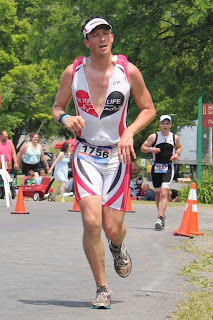
This picture sums up how I felt throughout the run.
I ended running a 2:15 half marathon (embarrassing) and finished with a total time of 5:44. My worst time since my first 1/2 Ironman, 4 years ago.
This is how badly the race went:

I coouldn't even get any love at the finish line. When it rains, it pours.
Conclusion:
Sometimes you just need to be humbled. Eating a piece of humble pie can be distasteful, yet necessary. I felt so confident entering into this race due to my previous success and continued improvement in each performance, but something had to give.
Of all of the questions I ask and negativity stated, all hold some sort of truth.
I didn't fully quit, but with the power of hindsight, I could have pushed myself through the heat and completed a 1:45 half marathon to finish with a total time of 5:13. This would have been much more respectable and would have given me a solid opportunity to qualify for the World Championship. Even if I didn't qualify, I would have moved up 20 positions in my age group and over 160 positions in the overall field. Huge difference.
I diseased myself with negative thoughts and couldn't find the strength to power through. I forgot previous lessons learn from earlier races and books of I have read. Stories from Dean Karnazes and Scott Jurek became lost memory when I needed to use them the most. I failed myself. It wasn't the day to set a personal record, but that shouldn't stop me from having a good day.
I will use this as fuel to propel me in my next race: Ironman 70.3 Timberman in Gilford, New Hampshire. My confidence and ego is definetely bruised, which isn't a bad thing since I have had a good run of races over the past 2 years. I needed to be knocked down. Not that I ask for this, but it was defnintely something that was going to happen eventually. Now, it is up to me to respond. Got to put in the work and continue to push myself.
Additional Notes:
Congratulations to Tom Holowka for finishing his second half ironman.
Congratulations to Jason Cosma for setting a personal record in his second half ironman. He beat his previous best by 20 minutes on a course that was tougher than Providence, RI and in much harder conditions. Well Done!
This was my first race with the Specialized SHIV, courtesy of Knapps Cyclery in Lawrenceville, NJ. It was the only positive I can take from this race. It was superb. The real improvement was in two areas: uphill and on flatland. The uphill is more impresiive as TT bikes are not known to be good climbers. However, with the aid of the UTI system, the electronic gear system was seamless in each hill I tackled, giving me the strength and cadence to attack the next obstacle. I look forward to riding with this new weapon in my future races.
Thank you to my sponsors: Knapp's Cyclery, Amino Vital & TGIFriday's for all of your support.
Photos Courtesy of Rachel Misenko

The goal of this race was to break 5 hours and qualify for the World Championship in Las Vegas on September 8. Even if I didn't break 5 hours but qualified for the WC, it would be an extreme success. I broke 5 hours earlier this season, but just barely (literally by 3 seconds) and understood that this was a more difficult course with hotter temperatures to contend with but as I found out through the race, I was unprepared for a lot going into this race.
The Swim
From reading previous posts, it is clearly evident, swimming is my weakest link... by far. I have recieved coaching and talked with a plethora of swimmers at the gym on how to improve but I simply cannot breakthrough. However, I have greatly improved since I have started doing triathlons, so I was banking on my training to mark that improvement.
First off, that swim was longer than 1.2 miles. With this being my 7th half ironman and hours of training in the pool, I have a pretty good grasp on the length I am swimming and that swim was not 1.2 miles. The course was laid out in a rectangle, my favorite (I hate the triangle configuration...don't ask why) but the width of the rectangle was longer than it should have been, by feel alone, I would have guessed the swim was about the distance of 1.35 or close to it. Nevertheless, I finished the swim at the time of 39:00, which isn't terrible by any stretch of the imagination.
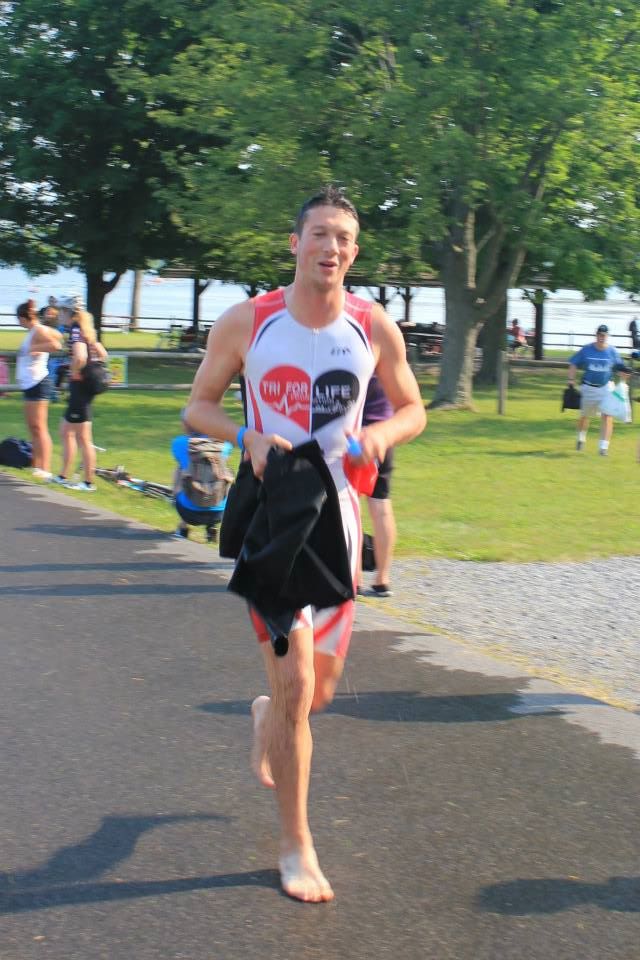
My good friend T-Money finished seconds before I did which was simultaneously pleasant and irritating.
Onto the transition and the bike...the race has started!
Transition 1
When the volunteers (excellent as always) ripped off my wetsuit, my timing chip was nowhere to be found on my left ankle... lovely. One volunteer looked and felt my swimsuit to see if the timing chip came off during the strip. No luck....brilliant. So I had to go to the race director and recieve a new timing chip. Add about a minute or two to my time. This is going really well. Stay positive! Onto to the bike!
The Bike
This is my strong point and this is where I am going to make up the time I lost in the swim.
Right in the beginning, I passed Tom and wished him good luck in the rest of the race. Now it is on to business.
Now, I have already rode this bike course so I felt comfortable riding hard and strong. On the contrary, I forgot a lot. The first 12 miles was completely uphill, which I remember fondly, but I considered the rest of the way to moderately easy and able to hammer through. I was dead wrong. For the first 35 miles of the bike portion, the course never let you get comfortable. At any point, I did not feel confident that I was making up any time. Continually looking at my GPS watch repeatedly reassured that confidence. I wasn't gaining any time. I was actually losing time. What was wrong? Did I not train hard enough? I am very good with my bike workouts including interval training and long, hard rides. I even did my infamous HillCrest repeats (anybody who lives in Central Jersey understands the relevance of how difficult that hill is). I was hydrating properly with water and Amino Vital Endurance. I executed each aid station with perfect precision (each aid station was expertly and excellently placed), so why was I doing so terribly?
The answer was simple: I greatly underestimated this course. I assumed I would average 22-23 mph throughout the course but the terrain suggested otherwise. I was able to catch up some time in the last 21 miles but couldn't only a muster an average speed of 20.3 mph equating to a total time of 2:43 for the bike. Respectable, yes, but I expect better.
The Run
Look how excited I was to finish the bike and start the run:
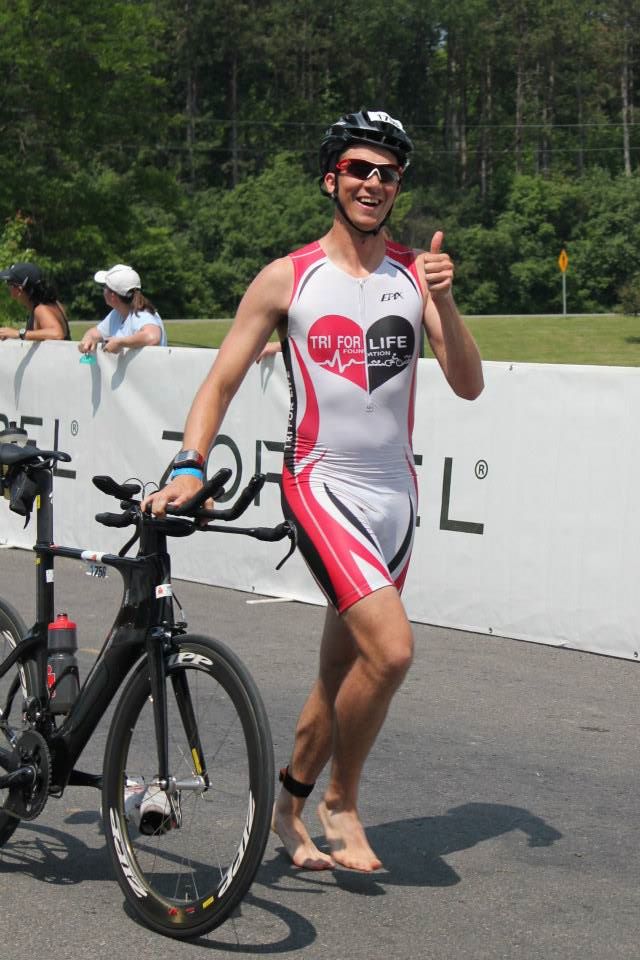
After the bike, I was ready to run. In the transition area, quickly changing, I felt good. I felt ready.
By this time, I accepted I would not break 5 hours unless I ran a 1:30 half marathon, which would be a personal best, but I still think I could qualify for the World Championship. Within the first two miles, I knew I was in trouble. I was averaging an 8:00 mile pace when I usually average a 7:45 pace. The negative thoughts immediately started to trickle in. Did I really not train hard enough for this race? More negative thoughts start flooding my brain.
I am nothing. I should just quit. You never push yourself when you need to. This is like basketball all over again (a story for another day). I am just not good enough.
Then the real truth set in.
It was 90 degrees, high humidity, high U.V. index, and no wind. I have consistently trained in weather at least 10 degrees cooler or more. I was not prepared for this type of heat and it destroyed me. Everytime I tried to pick up the pace, my body temperature started to rise exponentially. Everytime I charged up a hill, the heat charred my body even more. It became brutal. Every aid station started to become a lifeline. I desperately was trying to cool myself with sponges, ice down my shirt, cola, powerade, shot bloks, and water. It worked for a half mile after nourishing myself as best as I could and then it all went to hell. I ended up walking every hill. I could barely break 9 minute miles. I was being extremely humbled by the race course.
My father and wife-to-be were in attendance and I felt so ashamed of my running. Heading into lap 2, I apologized to them for my performance. Both gave me love and support in leiu of my condolences, which felt great for about two minutes, but then, it went back to s***.

This picture sums up how I felt throughout the run.
I ended running a 2:15 half marathon (embarrassing) and finished with a total time of 5:44. My worst time since my first 1/2 Ironman, 4 years ago.
This is how badly the race went:

I coouldn't even get any love at the finish line. When it rains, it pours.
Conclusion:
Sometimes you just need to be humbled. Eating a piece of humble pie can be distasteful, yet necessary. I felt so confident entering into this race due to my previous success and continued improvement in each performance, but something had to give.
Of all of the questions I ask and negativity stated, all hold some sort of truth.
I didn't fully quit, but with the power of hindsight, I could have pushed myself through the heat and completed a 1:45 half marathon to finish with a total time of 5:13. This would have been much more respectable and would have given me a solid opportunity to qualify for the World Championship. Even if I didn't qualify, I would have moved up 20 positions in my age group and over 160 positions in the overall field. Huge difference.
I diseased myself with negative thoughts and couldn't find the strength to power through. I forgot previous lessons learn from earlier races and books of I have read. Stories from Dean Karnazes and Scott Jurek became lost memory when I needed to use them the most. I failed myself. It wasn't the day to set a personal record, but that shouldn't stop me from having a good day.
I will use this as fuel to propel me in my next race: Ironman 70.3 Timberman in Gilford, New Hampshire. My confidence and ego is definetely bruised, which isn't a bad thing since I have had a good run of races over the past 2 years. I needed to be knocked down. Not that I ask for this, but it was defnintely something that was going to happen eventually. Now, it is up to me to respond. Got to put in the work and continue to push myself.
Additional Notes:
Congratulations to Tom Holowka for finishing his second half ironman.
Congratulations to Jason Cosma for setting a personal record in his second half ironman. He beat his previous best by 20 minutes on a course that was tougher than Providence, RI and in much harder conditions. Well Done!
This was my first race with the Specialized SHIV, courtesy of Knapps Cyclery in Lawrenceville, NJ. It was the only positive I can take from this race. It was superb. The real improvement was in two areas: uphill and on flatland. The uphill is more impresiive as TT bikes are not known to be good climbers. However, with the aid of the UTI system, the electronic gear system was seamless in each hill I tackled, giving me the strength and cadence to attack the next obstacle. I look forward to riding with this new weapon in my future races.
Thank you to my sponsors: Knapp's Cyclery, Amino Vital & TGIFriday's for all of your support.
Photos Courtesy of Rachel Misenko
Subscribe to:
Posts (Atom)